

We spoke with a family member of a child (a 6-year-old boy) with autism spectrum disorder.
After the transplant, we were pleased to hear from a teacher at the school who told us that communication has become easier. She told us that she is now able to look people in the eye and talk to them, that she is no longer affected by the weather, and that she is “amazed at the changes after the transplant.
[Profile]
6-year-old boy
H-kun
Disease name: Autism Spectrum Disorder
Transplant period:
May 11, 2021 – September 14, 2021
Transplant attending physician: Kawai Internal Medicine Clinic
(Click here for a list of articles from Kawai Internal Medicine Clinic)
Post-transplant diagnosis: clear improvement of symptoms
Q1. WHAT SYMPTOMS DID YOU SUFFER FROM BEFORE RECEIVING THE INTESTINAL FLORA TRANSPLANT?
I was working on nutritional therapy prior to my gut flora transplant, so let me walk you through the steps.
When something intriguing caught his eye, he would quickly run in that direction. In this way, my son was a child who never sat still for a moment.
He was not able to change his mind and sometimes hit people or things. He was not good at sensing the feelings of others, and this may have been why he would suddenly hug or push his teachers and friends, confusing them. Hugging and pushing can lead to injury if the wrong move is made. There were times when you almost got into trouble with your friends and their parents, and it was a mentally difficult time for you.
Defecation was another problem. Although he was supposed to have a bowel movement, my son did not seem to understand that it was a bowel movement. Therefore, I always had to put a diaper on him to avoid soiling his body and clothes.

Q2. WHAT WERE THE DECIDING FACTORS IN YOUR DECISION TO HAVE A TRANSPLANT?
Through exchanging information with parents I met at the rehabilitation center where I sent my son, I realized that there seemed to be some kind of connection between the intestinal environment and autism spectrum disorder.
From there, I did a lot of research, and what I found seemed to be “the one” was orthomolecular nutritional medicine.
I searched for a clinic near where I lived that practiced orthomolecular nutritional medicine, and I found Kawai Internal Medicine Clinic. This was the beginning of my relationship with Dr. Kawai.
The first thing we tried with the doctor was nutritional therapy, which was also the motivation for our visit. When we gave him the prescribed medication, we noticed various changes in our son.
One is defecation; I didn’t consider the once-every-two-days pace of defecation a problem, but the shape and color were different. I was surprised at the beautiful ochre-colored stools.
She has gone from being interested only in her own sphere of interest to trying to get involved with others.
The other thing is his sleeping habits. It was like I was forcing my son to sleep at night, but now he wants to get under the covers when he feels sleepy.
From these numerous growths, I realized the importance of the intestinal environment. I was fully satisfied at this stage, so when Dr. Kawai told me about the intestinal flora transplant, I was very worried about whether or not I would accept the transplant.
The reason I decided on the transplant was because of the “3 steps to remove bad things from the body” that Dr. Kawai had taught me.
If we apply my son to these steps, detoxification has three phases (phases 1-3), and since his last bowel movement is not going well (phase 3), the “expel bad things with stools” step is weak, and in the first place, abnormal intestinal flora is a major problem in ASD. He told us that one of the best solutions to this is a gut flora transplant.
Dr. Kawai, who has known my son for a long time and knows him well, made the suggestion. In the end, we decided to undergo the transplant based on our trust in him.
Q3. WHAT CHANGES DID YOU FEEL IN YOUR BODY AFTER THE TRANSPLANT?
Effects were seen during the transplant. The first was defecation. My son, who did not know when he needed to have a bowel movement, began to tell me “poop” and so on.
The shape and color of the stool itself became increasingly beautiful.
The stools after nutritional therapy were cleaner when I first started taking probiotics at the very beginning, but then there were periods of inconsistent color and hardness, and the transplant changed the color and hardness of the stools considerably. I think they were not hard enough compared to after the transplant.
I am also very grateful for the fact that he has reduced his hugging and pushing behaviors, which are the source of many of the problems that plague him. Looking back, the cause of these problematic behaviors may have been my son’s lack of consideration for others. He would be surprised if he was suddenly hugged, and would feel pain and sad if he was pushed. If a friend is crying, you can even console him or her. I am amazed at how much he has grown beyond my imagination.

Q4. FINALLY
Since the beginning of my nutritional therapy, I have been very careful about diet and exercise.
Vegetables should include more root vegetables that are high in fiber. Meat and fish are well-balanced. Gluten-free and casein-free have been prioritized, and processed foods and foods with pesticides have been avoided.
To further promote toxin elimination, we use bath salts that also provide minerals from the skin.
Before the transplant, I was inclined to “do as much as I can” to maintain such an environment, but now that I have received the intestinal bacteria, I have changed my mind to “provide better support to protect these bacteria.
With our support, my son entered elementary school in April and is enjoying his daily life in good health. Eventually, I want him to be able to live a happy and healthy life without help. Now that he has undergone two treatments, I strongly believe that.

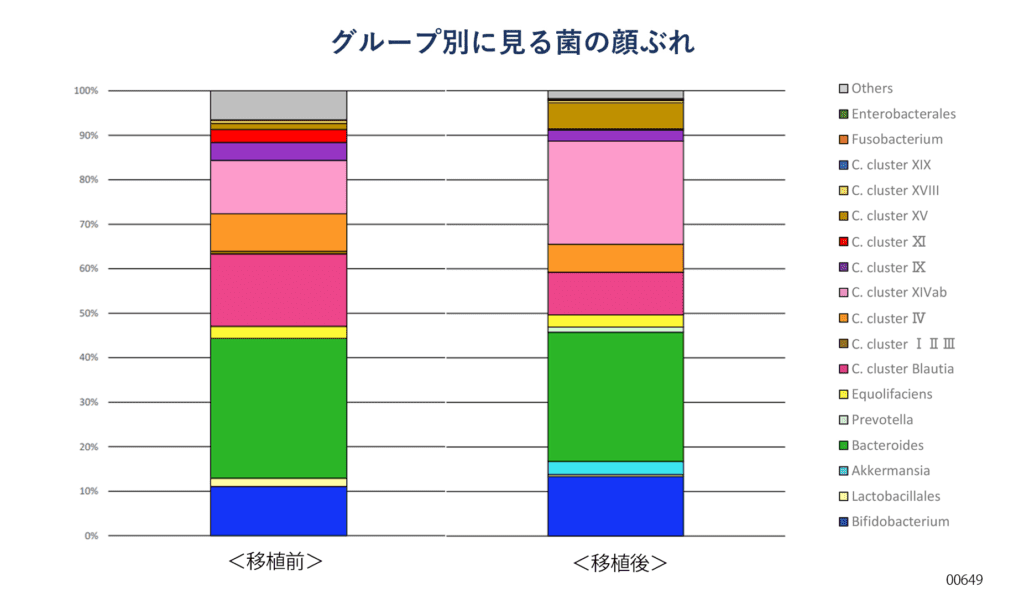
▼Flora balance test results