

We spoke with a family of a child with autism spectrum disorder.
He had been having tantrums since he was in his 1’s and at his 1-6 month checkup, it was noted that he was delayed in speech.
She was having trouble with tantrums and throwing things, and her preschool teacher referred her to a clinic, where she decided to have a transplant.
Please take a look at the changes before and after the transplant.
[Profile]
4-year-old boy
T-kun
Disease name: Autism Spectrum Disorder
Number of transplants:
July 31-September 4, 2021 Course of 6 transplants
November 27, 2021-March 5, 2022 3 additional transplants
Transplant attending physician: Kitamura Clinic
(Click here for a list of Kitamura Clinic articles)
Post-transplant diagnosis: symptoms Improvement
Q1. WHAT SYMPTOMS DID YOU SUFFER FROM BEFORE RECEIVING THE INTESTINAL FLORA TRANSPLANT?
There were many symptoms and behaviors that concerned me. First were the tantrums: he would throw several tantrums a day, with each tantrum lasting up to 40 minutes, and he would cry for as long as 40 minutes. If we went to places he had never been before or to crowded places, he would panic, and there was a high probability that this would lead to a tantrum.
I was also having trouble with the act of throwing things. When I was talking with a teacher at the daycare center, my son’s thrown objects would fly right by my face. I was worried that he might injure his friends as well as adults.
Then there was the defecation problem that motivated the transplant. I had to wear a diaper at all times because I could not communicate urine well. His stools were somewhat hard and cracked with little water every two days. Even if we tried to improve the condition of his stools by having him drink water, he did not want water very much, so we had to try many different ways to help him. It must have been hard on our son, but we parents were also exhausted from being pushed around by him.
Q2. WHAT WERE THE DECIDING FACTORS IN YOUR DECISION TO HAVE A TRANSPLANT?
It was a teacher at my son’s preschool who told me about the intestinal flora transplant. The teacher’s child also has autism spectrum disorder and received the transplant to improve his symptoms.
My child had a transplant and his growth accelerated. He introduced us to the Kitamura Clinic, saying, “If you would like to talk to us, why don’t you?
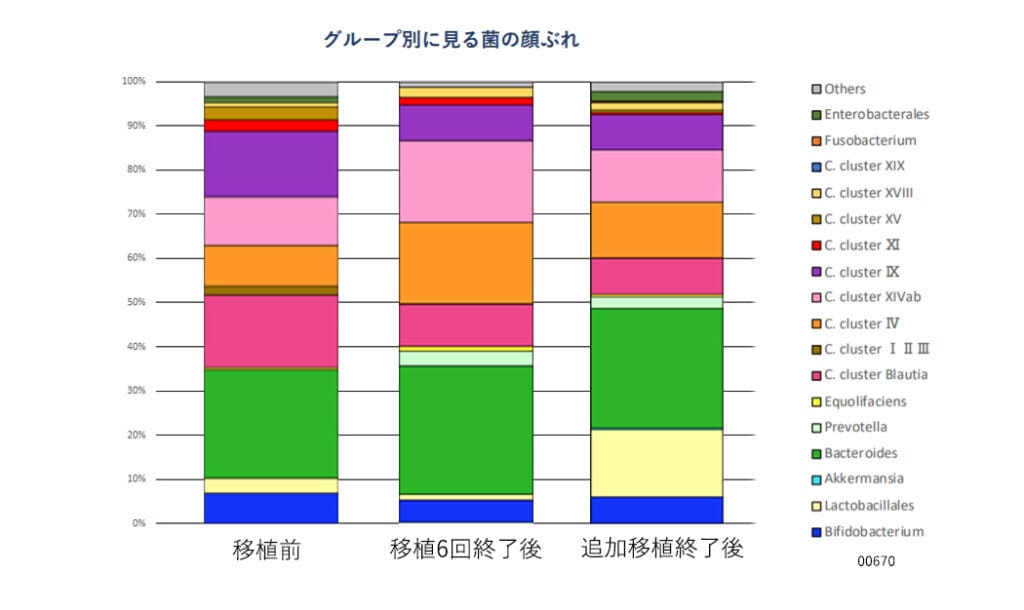
Dr. Kitamura gave us a detailed explanation, showing data from a patient with autism spectrum disorder and a similar age to my son. Even putting aside the fact that intestinal flora transplantation itself is still in the clinical research stage and the number of patients is small, the data was enough to make me believe in the possibility and give it a try.
Our desire to improve our son’s condition, our desire to change our own exhausted situation, and the numerical information here combined to make us decide on the transplant.

Q3. WHAT CHANGES DID YOU FEEL IN YOUR BODY AFTER THE TRANSPLANT?
With each transplant, I saw small changes in my son. The most noticeable was ‘language’.
Until now, I could not put my feelings into words and always looked frustrated. Now they are able to express what they see in a way that conveys to us what they see, such as “the traffic light turned green,” “blue means go forward,” and “red means stop.
THE TEACHER AT THE REHABILITATION CENTER WAS SURPRISED AT THIS, SAYING, “IT IS DIFFICULT TO STABILIZE EMOTIONS TO THIS EXTENT EVEN WITH ABA (APPLIED BEHAVIOR ANALYSIS) BASED THERAPY,” SO I THOUGHT, “AH, IS THIS THE RESULT OF THE TRANSPLANT? I WONDERED IF IT WAS THE RESULT OF THE TRANSPLANT.
The duration and frequency of the tantrums, which would have been hard on him, have also decreased dramatically. The tantrums that used to occur so frequently before the transplant now occur two to three times a week, and each tantrum lasts less than 10 minutes. The tantrums, which used to be frequent before the transplant, were now two to three times a week, and each tantrum lasted less than 10 minutes.
Panic rarely occurs anymore, and I can now behave calmly in crowds of people, which was completely impossible before the transplant. I can now enjoy eating at the food court, and the number of places we can go out as a family has increased dramatically.
I know this is a bit forward, but perhaps it is synergistic with the fact that we are beginning to figure out our son’s tantrum patterns.
For example, create a schedule. On a whiteboard, with pictures and text, I visualized the schedule: “Friday is preschool, and then we go to the teacher’s office. On Saturday, we will go to grandma and grandpa’s house.
The fact that he is now able to predict for himself how many more sleeps he will need before he can go to his grandparents’ house should also play a role in his tantrums.
However, it is not all good. The improvement in the defecation situation, which I was most excited about, is a struggle and can be found at …….
I was told that the transplant had improved the intestinal environment, and that this was the result of an improvement in leaky gut syndrome (a disease that causes holes in the intestines and has various adverse effects on the body), but my stools were harder than they had been before the transplant.
It was extremely difficult to get my son, who does not drink much water, to drink hydrogen water from the Intestinal Flora Transplant Clinical Study Group. I try to improve the hardness of his stools by mixing it with flavored commercial water, offering him water when he goes out and gets thirsty, or any other way I can to get him to drink water.
As for food, we know that certain foods are bad for my son’s intestinal tract, so we have asked the daycare to help us with a medical report stating this.
Especially with vegetables, they don’t like the mere sight of a piece, so I cook them in a way that makes it difficult for them to see the shape of the vegetable, such as curry or stew. Furthermore, when the younger child seems to be enjoying the food, I let him try it without hesitation. And when he swallows it properly, I praise him anyway. Through these repetitions, the number of foods he can eat has increased considerably.
As for water, these days, “I’ll have a cup of tea.” I want a yogurt-flavored drink. The children are now requesting and drinking water on their own initiative. We have prepared several kinds of flavored water such as yogurt, grape, and peach flavored water, and if we mix them with hydrogen NanoGAS® water, they are able to drink it without resistance. In addition, there is no resistance at all to drinking tea or 100% juice mixed with Hydrogen NanoGAS® Water. I feel that he is making progress in drinking water.
I mentioned seeing how my sister was doing, which was also unthinkable before the transplant. Even when we were in the same place, such as the living room, we just shared the space and did not try to play together. Now, when he doesn’t see his sister, he asks us, “Where is she?” and they even started to play chase with each other. I think this is a sign that she has shifted from pursuing only her own interests to focusing on her sister and our family. I can’t say how I feel, knowing that she is expanding her field of vision from her relatives to third parties.

Finally.
Looking back, I think that before the transplant, my son did not really understand how to interact with others. Since his social skills are beginning to expand richly with the transplant, I hope that he will play with his sister and friends more and have many more experiences of “enjoying interacting with others.
He still has some problem behaviors, such as throwing things and pushing his sister down, and I would like to guide him to eliminate these in order to build relationships.
I hope that after they have developed their social skills in this way, they will find something they like to do and work hard at it. I hope that this will lead to a job in the future.
My son’s favorite thing right now is bird watching. I am amazed at how he finds and points out birds one after another as we walk around. I hope he can become a bird version of “Sakanakun”.

▼Flora balance test results