

- We are pioneers of stool transplants. [Just before the Annual Meeting, a glimpse Vol. 1
- Making Fecal Transplantation a Safe Treatment [Last-minute Glimpse before the Annual Meeting Vol. 2
- Atopy and Brain-Gut Correlation, Intestine-Dermal Correlation [Just before the Annual Meeting, Glimpse Vol. 3].
- Three cases of irritable bowel syndrome that showed improvement with transplantation [Flyer just before the Annual Meeting, Vol. 4].
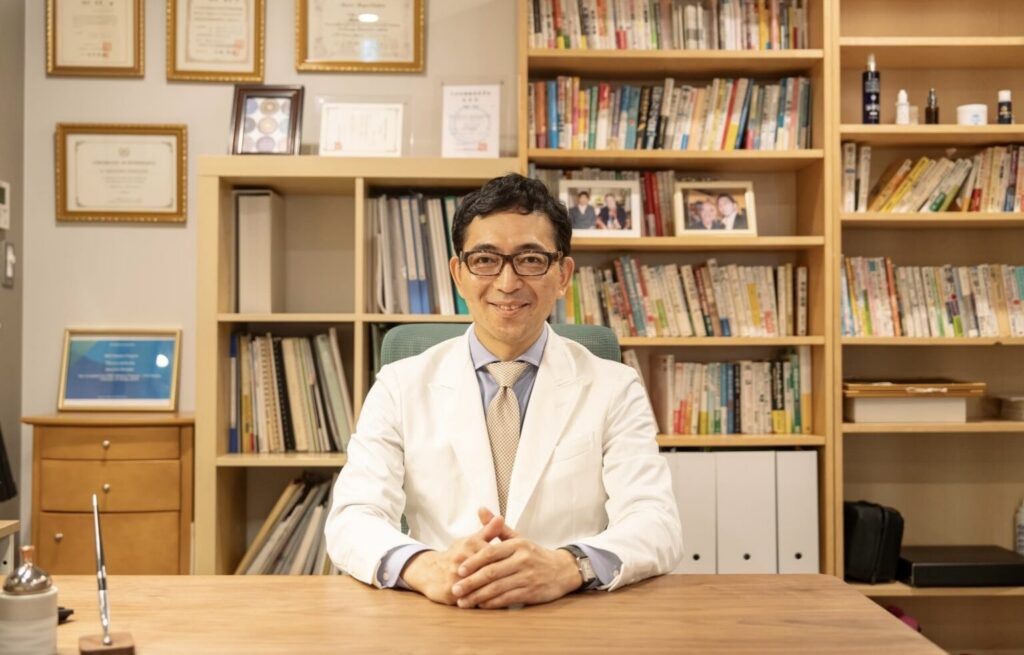
Today, I would like to introduce Dr. Kitamura of the Kitamura Clinic in Fukuoka Prefecture.
Dr. Kitamura, I was moved like a demon by the message on your site. Thank you for bringing out my organic acid-producing capacity during the stressful period before the General Assembly.
No, no, no, I am just stating the obvious.
Do you guys want to read it?
Got your tissues ready?
It has been more than 20 years since I started working on cancer treatment.
During my university hospital days, I practiced cancer treatment with the so-called “three major therapies” of surgery, anticancer drugs, and radiation, but I soon realized their limitations.
The treatments that I continued for the sake of my patients were causing them mental and physical suffering due to side effects, and I felt myself becoming worn out by the frustration of wanting to help them heal but having no way to do so.
It was during this time that I came across integrative medicine. My encounter with integrative medicine was a major turning point for me as a physician.
Integrative medicine is a multidisciplinary approach to treatment that is not limited to modern Western medicine, but also focuses on lifestyle and complementary and alternative medicine.
I have experienced many times when patients who had been told by standard treatment that there was nothing more to be done for them, had their faces light up when they encountered integrative medicine and realized the possibilities of treatment.
I will continue to do my best to help patients suffering from cancer become vigorous and energetic through integrative cancer treatment and preventive medicine.
It’s true, isn’t it? You are absolutely right. (poor vocabulary)
I think it’s important for both doctors and patients to have a tolerant attitude, rather than being biased one way or the other.
Let me now introduce Dr. Kitamura’s abstract.
A case of autism treated with intestinal flora transplantation that improved symptoms.
Autism is a neurodevelopmental disorder, now called Autism Spectrum Disorders : ASD. The main symptoms include difficulties with social behavior and interpersonal communication, repetitive behaviors, and a strong preoccupation with certain things.
In recent years, the number of patients has been increasing not only in Japan but also worldwide, with a high incidence rate of 1 in 62 reported in Japan and 1 in 59 in the U.S., and the disease has been discussed as a social problem.
TREATMENT OPTIONS FOR ASD INCLUDE BEHAVIORAL, SPEECH, AND SOCIAL THERAPY, PSYCHIATRIC PHARMACOTHERAPY, AND DIETARY AND METABOLIC NUTRITIONAL THERAPY, BUT TREATMENT IS CHALLENGING.
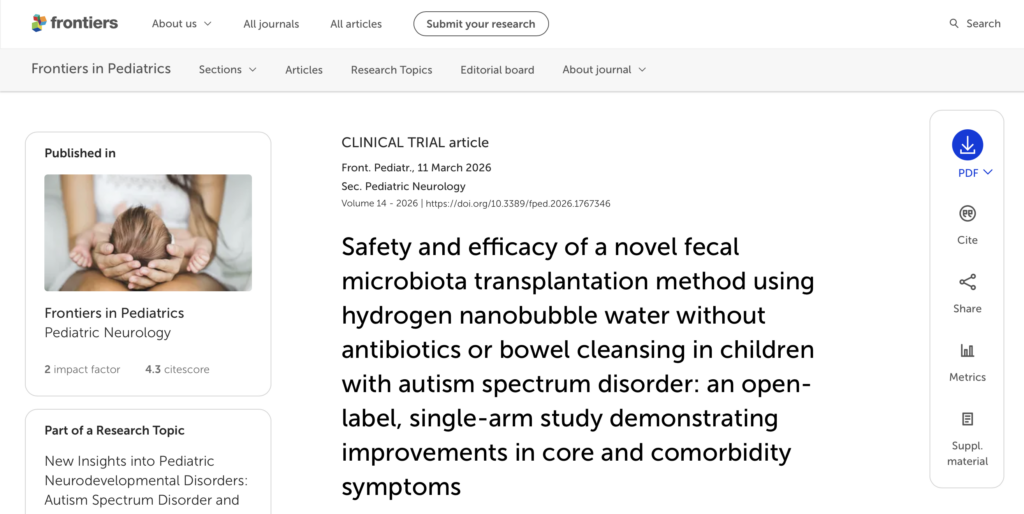
The gut-brain relationship, in which the gut microbiota affects the brain in various ways, has become widely known, and abnormalities in the gut microbiota of ASD patients have been reported in many cases. Fecal microbiota transplantation (FMT) is a promising treatment to improve gastrointestinal and behavioral symptoms of ASD.
The University of Arizona followed ASD patients treated with Microbial Transfer Therapy (MTT) for two years and found improvement in gastrointestinal symptoms and a 45 percent improvement in social behavior. They also reported that ASD symptoms slowly improved after treatment.
IN THIS STUDY, A 7-YEAR-OLD FEMALE CHILD WITH ASD WAS TREATED WITH INTESTINAL FLORA TRANSPLANTATION. WE REPORT SOCIAL BEHAVIOR AND GASTROINTESTINAL SYMPTOMS THAT CHANGED OVER THE COURSE OF TREATMENT. THIS CASE SUGGESTS THAT INTESTINAL FLORA TRANSPLANTATION MAY BE EFFECTIVE IN THE TREATMENT OF ASD.
Autism and intestinal flora transplantation is now a big topic of interest, with surprisingly high response rates reported above and beyond other intestinal diseases.
You’ve written about autism before on the Symbiosis Institute blog.
Autism and intestinal flora transplantation seem to be a good match. [Discussion of target disorders and methods.
That’s right. Thanks, Hanako. It’s hard for me to advertise myself…
Oh, by the way, there is also this article.
[After Autism] A discussion of protocols and time differences for improvement in stool transplants.
You’re advertising, aren’t you?