

The relationship between Autism Spectrum Disorder (ASD) and gut bacteria has been the focus of many clinical studies and trials in recent years. It is known that the gut and brain influence each other through nerves, immunity, and metabolism, and this relationship is called the “gut–brain axis.”
Recent clinical studies have reported that the composition of gut bacteria in children with Autism Spectrum Disorder may differ from that of typically developing children, and that there are relatively many cases where gastrointestinal symptoms occur simultaneously. Therefore, clinical studies investigating the relationship between the gut environment and neurodevelopment are being conducted worldwide.
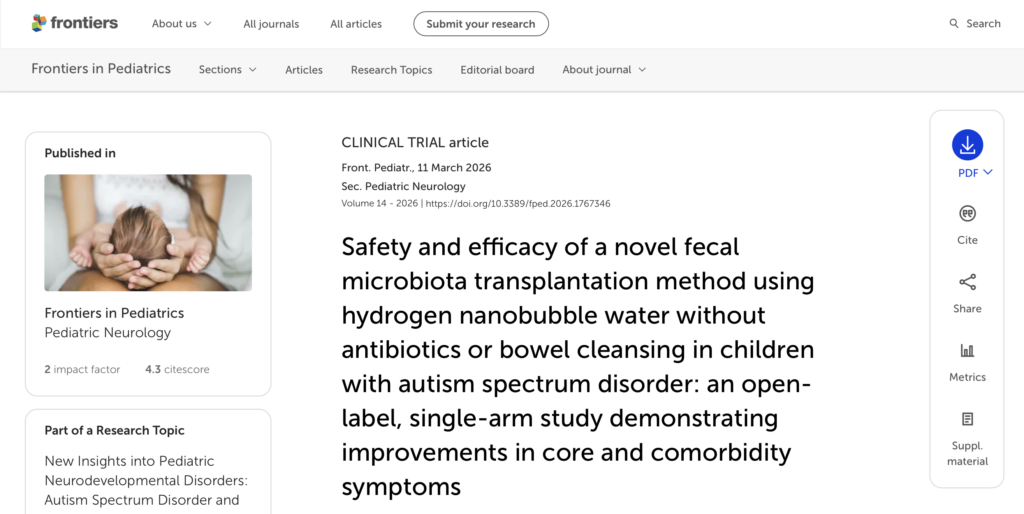
As one of these clinical studies, a study regarding the safety and efficacy of a new NanoGAS®-FMT method using NanoGAS® hydrogen water for children with Autism Spectrum Disorder was published in the medical journal Frontiers in Pediatrics.
In this article, based on this research paper, we will explain the following in a way that is understandable to general readers:
- The relationship between Autism Spectrum Disorder and the symbiotic microbiota
- What FMT research is
- Characteristics of this clinical study
- Clinical Study Results
- Significance and discussion of the clinical study
Please note that this article is intended to explain the content of the clinical study and does not indicate specific therapeutic effects.
Clinical studies on Autism Spectrum Disorder (ASD) and gut bacteria have a long history.
Autism Spectrum Disorder (ASD) is a neurodevelopmental disorder characterized by difficulties in social communication and repetitive behaviors. While the cause of onset has not been fully elucidated, it is believed that genetic and environmental factors are intricately related.
In recent years, one of the themes attracting attention in these clinical studies is “gut bacteria.” Tens of trillions of microorganisms exist in the human gut and are involved in various physiological functions such as digestion, immunity, and metabolism. These gut bacteria and their metabolites are referred to as the “gut microbiota (intestinal flora).”
Recent clinical studies suggest that the gut microbiota may influence brain function and behavior, and this relationship is called the “gut–brain axis.” In the field of Autism Spectrum Disorder research, many clinical studies have reported that the composition of the gut microbiota may differ from that of typically developing children. It is also known that there are many cases where gastrointestinal symptoms such as constipation or abdominal pain occur simultaneously.
Against this background, clinical studies investigating the relationship between the gut environment and neurodevelopmental disorders are being conducted worldwide.
Fecal Microbiota Transplantation (FMT) Drawing Attention in Autism Spectrum Disorder (ASD) Clinical Studies
Within clinical studies investigating the relationship between the gut microbiota and Autism Spectrum Disorder (ASD), clinical studies are also being conducted to examine what changes in symptoms are observed when the gut environment is altered. One of the methods to change this gut environment is Fecal Microbiota Transplantation (FMT).
FMT is a method of transplanting the gut microbiota of a healthy person into a patient’s gut to alter the composition of the gut microbiota. While this technique originally developed in the field of gastrointestinal diseases, in recent years, the relationship between the gut microbiota and various diseases has attracted attention, and it is now being applied in the field of research regarding neurodevelopmental disorders.
However, gut microbiota research remains an evolving field, and caution is required in interpreting the results of these clinical studies.
What is new about the clinical study using the NanoGAS®-FMT method?
A key characteristic of this clinical study is the adoption of the FMT method using NanoGAS® hydrogen water (Hydrogen nanobubble water) as a solvent.
NanoGAS® hydrogen water is water containing extremely small hydrogen bubbles (nanobubbles), and it is one of the technologies being researched in the fields of engineering and medicine. In this clinical study, we performed Fecal Microbiota Transplantation (FMT) using this NanoGAS® hydrogen water method.
In conventional FMT clinical studies, methods involving the use of antibiotics and intestinal cleansing in advance have often been used to make it easier for the donor’s bacteria to colonize. By doing so, the objective is to reduce the patient’s own gut bacteria once, creating an environment where new bacteria can easily colonize.
On the other hand, the method we used in this clinical study does not involve the use of antibiotics or intestinal cleansing. A key characteristic of our approach is using NanoGAS® hydrogen water to significantly change the oxidized intestinal environment, preparing an environment where bacteria can easily colonize.
Clinical Study Results: Improvements in SRS-2 Scores and Changes in the Gut Microbiota
In the clinical study, we observed both changes in the gut microbiota and behavioral evaluations.
Approximately 30 weeks after performing FMT, a reconstruction of the gut microbiota was observed. In particular, an increase in bacteria that produce short-chain fatty acids has been confirmed. Short-chain fatty acids are known as metabolites of gut bacteria, and it has been reported that they may be related to intestinal function and immunity.
For behavioral evaluation, the SRS-2 (Social Responsiveness Scale), an index for evaluating the social behavior of Autism Spectrum Disorder, was used.
The clinical study reports that
the SRS-2 scores decreased by an average of 29%
(p < 0.001).
While the SRS-2 is a parent-completed rating scale, this clinical study also utilized the eye-tracking tool “Gaze finder” to supplement the objectivity of the results. In the research paper, a correlation between the evaluations of social communication and the Gaze finder results was also confirmed, positioning it as auxiliary information that supports the validity of the SRS-2 evaluations.
Furthermore, it is reported that these changes were maintained not only during the observation period but also
at the one-year follow-up.
Changes were also observed in the symptom classification, reporting that:
・19 severe cases showed Improvements to the mild range
・6 cases showed Improvements to the normal range.
In addition,
Improvements of 30–61% were reported to have been observed in indices such as:
・Social communication
・Repetitive behavior
・Sensory symptoms
・Gastrointestinal symptoms
・Emotional symptoms.
Safety: What were the Adverse Events?
In this clinical study, we adopted strict standards for the quality control of the bacterial solution used to ensure safety. The bacterial solution used in the clinical study was prepared in accordance with the Investigational Medicinal Product GMP (Good Manufacturing Practice) guidelines.
We implemented processes such as donor selection, preparation, and storage of the bacterial solution based on the same quality control concepts as pharmaceuticals. Such manufacturing control is considered an important factor in evaluating the reproducibility and safety of the clinical study.
Important results were also reported from a safety perspective. During the clinical study period, no Severe Adverse Events were reported. In a clinical study, confirming safety is considered an extremely important evaluation item alongside efficacy. It has been reported that no Severe adverse events were confirmed during the observation period of this clinical study.
Where does this clinical study stand within international research trends?
Clinical studies on the relationship between gut bacteria and neurodevelopmental disorders are currently being conducted worldwide.
In particular, many clinical studies using Fecal Microbiota Transplantation (FMT) have been reported over the last decade or so.
In conventional FMT clinical studies, methods involving the use of antimicrobials and intestinal cleansing before transplantation to reduce the patient’s own gut bacteria before transplanting the donor’s bacteria have often been used.
On the other hand, this clinical study is characterized by the following points:
Not using antimicrobials
Not performing intestinal cleansing
The method using NanoGAS® hydrogen water
The approach of performing the transplantation while maintaining the existing gut bacterial environment, rather than significantly changing it, is a different method from conventional clinical studies.
Additionally, in this clinical study, we simultaneously observed:
Changes in the gut microbiota
Behavioral evaluation using the SRS-2
Long-term follow-up
Safety
There are still not many clinical studies that have simultaneously observed changes in the gut microbiota and behavioral evaluations, and clinical studies reporting results up to long-term follow-up are also limited.
As an example of a clinical study with these characteristics, this clinical study was published in the medical journal Frontiers in Pediatrics.
Frontiers in Pediatrics is one of the international, peer-reviewed open-access journals in the field of pediatrics, where research results from researchers around the world are published.
Points that experts (peer reviewers) focused on
Before this clinical study was published in the international medical journal Frontiers in Pediatrics, it underwent peer review by several experts. During peer review, the research methods, safety, and reliability of the data are examined in detail.
In this clinical study, the research methods, safety, and reliability of the data were key confirmation points during the peer review process. The following three characteristics of this clinical study are particularly important for general readers to understand.
① FMT without the use of antimicrobials
While conventional FMT clinical studies often use antimicrobials and intestinal cleansing, we adopted a method that does not use them in this clinical study. This approach attempts to have the bacteria colonize without significantly changing the intestinal environment.
② Detailed reporting on safety
In clinical studies, confirming side effects and Adverse Events is an important evaluation item. We confirmed that no Adverse Events occurred during the observation period of this clinical study.
③ Preparation of bacterial solution based on GMP
The bacterial solution used in the clinical study was prepared according to GMP guidelines, which is one of the factors supporting the reliability of the clinical study from the perspective of quality control.
Limitations and Future Clinical Studies
While this clinical study reports important observations, we must also consider several limitations when understanding the Clinical Study Results.
First, this clinical study was conducted as a single-arm study without a control group. Therefore, it may be difficult to clearly distinguish whether the observed changes were due to Fecal Microbiota Transplantation (FMT) or other factors.
Additionally, since the number of participants in the clinical study was limited, larger-scale clinical studies are required to generalize the results more broadly.
Research on gut bacteria is a field that continues to develop rapidly, and we expect that knowledge will be accumulated through further clinical studies in the future.
Summary: Clinical studies on gut bacteria and Autism Spectrum Disorder (ASD) will continue in the future
Many clinical studies have been conducted in recent years regarding the relationship between Autism Spectrum Disorder and the gut microbiota.
In the clinical study introduced this time, we observed and reported:
・Changes in the gut microbiota
・Changes in behavioral evaluations
・Safety
through FMT using NanoGAS® hydrogen water.
In particular, the fact that it was reported as a new FMT approach that does not presuppose the use of antimicrobials or intestinal cleansing is a point of interest when considering future research trends.
However, this clinical study was conducted as a single-arm clinical study, and the number of participants was limited. In order to interpret these results as general therapeutic effects, verification through further large-scale clinical studies and comparative clinical studies is required in the future.
Clinical studies on the relationship between gut bacteria and neurodevelopmental disorders are still ongoing worldwide, and we expect that understanding will deepen through many more clinical studies in the future.
The clinical study introduced here was published in the medical journal Frontiers in Pediatrics in March 19, 2026 (Thu).