

Mr. K with autistic spectrum disorder.
Before the transplant, he had been throwing fire tantrums, crying violently, etc., when his obsessions and daily routine were disrupted.
We asked Mr. K’s family about what happened before and after the intestinal flora transplantation and the changes that occurred after the transplantation.
[Profile]
6 years old, boy
Disease: autism spectrum disorder
Transplantation period: February 7, 2022 – February 18, 2022
Transplant course: 3 transplants
Transplant attending physician: Luke’s Ashiya Clinic
Post-transplant diagnosis: symptoms Improvement
Q1. What symptoms did you suffer from before receiving the intestinal flora transplant?
When his obsessions and daily routines were disrupted, he would throw a fiery tantrum. By “routine,” I refer to the actions that were set in my son’s mind, such as which toys to bring to his bedroom, the order in which to turn off the lights, and touching a certain spot. If even one of these is disrupted, he will cry violently or hit his head repeatedly on the floor, making it impossible for him or those of us watching over him to go to his bedroom. There were days when he could not sleep until 1 to 3 a.m. and it was very hard on his body.
What was difficult to deal with was the fact that routines were always increasing. I watched my son and tried to keep him away from behaviors that I thought might become an obsession before they actually became an obsession, but it was not easy to do.
Besides the tantrums, the other thing that concerned me was the lack of interest in other people. In children with typical development, if a parent encourages speech or hand play, they will mimic the behavior. My son, however, shows no interest in us. He only does what he is interested in. Even at the daycare center he attended, he seemed to be a child who played alone in his own world.
Q2. What made you decide to have a transplant?
Foreign papers and domestic experiences are the direct deciding factors.
It was about one year before I received the transplant that I learned about the intestinal flora transplant itself. I learned about the correlation between autism spectrum disorder and the intestinal environment on the Internet, which led me to research papers on intestinal flora transplantation overseas and transplant cases in Japan. It was also around this time that I learned about the existence of the Intestinal Flora Transplantation Clinical Study Group and the academic conference held by the study group. I attended the academic conferences, asked questions to the professors, and learned about intestinal flora transplantation.
Of the doctors with whom I had a conversation, I actually visited Dr. Shirotani’s Luke’s Ashiya Clinic. I visited there because I wanted another push to make a decision for transplantation, and I also heard a new story about nutritional therapy, such as, “The ideal way is to improve the intestinal environment through nutritional therapy using dietary improvement and supplements, and as a result, relieve the symptoms of autism spectrum disorder. We challenged the nutritional therapy and eventually asked Dr. Johtani to perform an intestinal flora transplant for our son.

Q3. What changes did you feel in your body after the transplant?
After the first transplant, I felt that my son’s mood had changed. Normally, he is so tense that even a single trip to the convenience store can cause him to run around screaming and make a huge scene. After the transplant, however, he was able to shop quietly.
In addition to the overwhelming reduction in tantrums, I have been amazed at how the routine has become less extended. Irregularities, such as when our son has an unknown guest who comes and stays for an extended period of time, are indeed stressful and can cause tantrums, but tantrums in daily life have decreased and he is now in a rhythm where he usually eats and goes to sleep at a regular time. The burden on us parents has also decreased, and life has become easier for both our son and us.
They are now responding to speech and hand games that they did not accept at all before. When he is thirsty, he asks for juice, and when he falls down, he shows abrasions and complains that it hurts. I think it is a big change that my son, who could only communicate his needs by crying, now has a “voice” to communicate, albeit a muffled one.
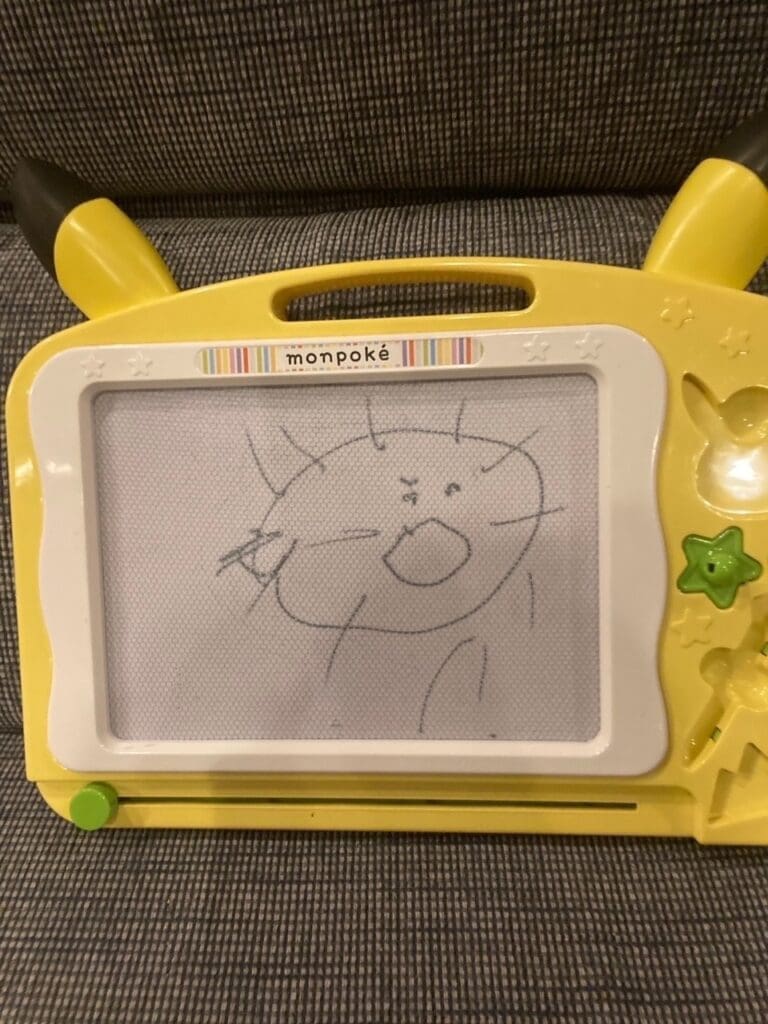
↑A picture drawn by a child with autism spectrum disorder (photo provided by the family)
Q4. What did you work on during and after the transplant?
Nutritional therapy. Dr. Shirotani has taught me what nutrients my son is lacking, and I make a powder of supplements to supplement those nutrients and mix them into his food and drinks. I have also been told that intestinal bacteria prefer the good quality sugars available from root vegetables, so I have been creating a menu with more root vegetables.
I have been advised to avoid sugar and flour as much as possible, but I am struggling with this. My son loves foods with sugar and flour, so he eats them up. I am not doing everything I can, but I think it is important to keep it at a level where he doesn’t notice it, because if I restrict him too strictly, he will probably become stressed.
Another thing I am conscious of continuing is walking hand in hand. For a child with autism spectrum disorder, it is difficult to walk at a pace with a partner. In the beginning, he immediately let go of my hand and ran away. After the transplant, he is able to continue walking hand in hand, and in general, I feel that his human-like behavior is increasing.

Finally.
I believe that intestinal flora transplantation is a medical treatment that will attract more and more attention in the future. However, depending on how it is communicated, some parents may take it as a “magical treatment that cures autism spectrum disorder.
The reason that children with typical development increase their speech and behavioral variations with age is because of the experience they have accumulated over the course of their growth. Transplants do not confer even experience, so there is no hope for a magical change. When considering transplantation, it is advisable to consult with the doctor thoroughly about the expected benefits and precautions, rather than simply deciding “to do or not to do”.
On the other hand, there are several points that we would like to see devised on the part of the doctor providing the treatment. Although we were fully informed and satisfied with the explanation leading up to the transplantation, we left the selection of the fungal solution to the doctor and the research group. The patient does not know “what criteria are used to select the solution. I hear that there are cases in which improvement is difficult to achieve, so I think it would lead to a sense of satisfaction if the doctor and the research group could join us in discussing not only the criteria for selecting the solution, but also what kind of solution to use.
Since his transplant, my son has been able to “build on his experiences” and enjoy them on a daily basis. I am sure that many more important events will occur in the future for my son, and he will have more opportunities to take on challenges. Compared to before the transplant, when I was only worried about my son’s future, now I am looking forward to his future. The transplant was for the child, but I think it would be a good idea for us parents to consider it for our own lives as well.